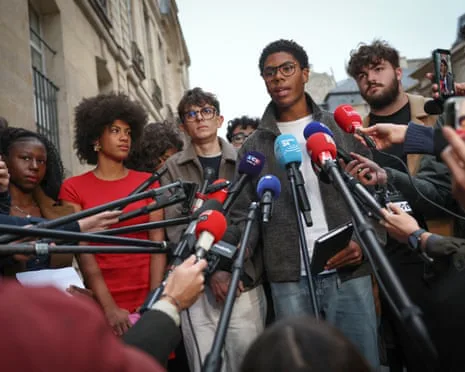
Representatives of Les Lycéens speak to reporters on Monday after meeting the prime minister, Sébastien Lecornu, in Paris. Photograph: AFP/Getty Images
French student activists say they will continue blocking schools and joining street protests until the government meets more of their demands. Their statement came on Monday after officials announced new plans to tackle problems in the country’s education system.
The government has promised steps to reduce overcrowded classrooms, improve school buildings and review the university application process. But student leaders say these promises are not enough.
“We need real action, not half measures,” said Pierre Sourzat of the student group Les Lycéens in an interview with France Info television.
He said students were now able to discuss their demands directly with the government. However, he called on young people to keep protesting to win as many changes as possible.
Students demand better schools
The protests began in September, and school blockades have continued for more than five weeks. The movement has grown into one of the largest youth protest campaigns France has seen in years.
Trade unions and people angry about the rising cost of living have also joined regular demonstrations held on Saturdays.
Students say many schools are in terrible condition. Some buildings have damaged ceilings, mould, broken toilets, too few chairs and windows that cannot close properly.
They are also demanding more teachers and other school staff to ensure students receive a proper education.
Education Minister Édouard Geffray admitted that some school buildings were in such poor condition that they were not suitable for teaching.
He announced a government loan worth €4 billion to help regional authorities begin repairing school buildings.
Government promises smaller classes
The government also announced plans to reduce overcrowding in classrooms.
Under the new measures, classes for 15-year-olds in their first year of high school will be limited to 28 students in schools serving the lowest-income areas. These schools make up about half of the country’s high schools.
The government plans to extend the class-size limit to all high schools the following year. It has also promised to create more teaching jobs and review the French baccalaureate, the qualification students take at the end of secondary school.
Officials also plan to change Parcoursup, the online system used to apply for university places. Critics say the system is difficult to understand and treats applicants unfairly.
The government says the current system will be changed in 2027 and replaced with a new one in 2028. Parliament is also due to debate the issue on Wednesday.
Higher Education Minister Philippe Baptiste announced plans to create 15,000 additional places in higher education, with a focus on vocational training.
Students say the fight is not over
Louis Letoublon, another member of Les Lycéens, attended a meeting with Prime Minister Sébastien Lecornu.
He praised students who had taken part in the protests, saying their actions had forced the government to listen and respond.
However, he stressed that the government had not met all their demands and said the movement would continue for as long as necessary.
Baptiste said the government remained willing to hold further talks with student representatives.
Protests bring violence and arrests
The demonstrations have also led to serious clashes and growing concerns about public safety.
Several young people have reportedly suffered serious injuries, including injuries allegedly caused by explosive weapons used by police. Hundreds of children have also been arrested and taken into police custody.
After major violence on October 17, authorities introduced tighter security measures. That day saw looting, fires and damage to public buildings.
Some cities introduced curfews and banned certain protests. On Saturday, officials moved some demonstration routes to areas outside city centres. The protests were mostly peaceful.
Interior Minister Laurent Nuñez said another worrying development had appeared in cities such as Nice and Montpellier. He said far-right groups had arrived in organised groups and targeted protesters. Eleven suspects are expected to face charges.
Authorities have also admitted that failures in security and intelligence helped create the conditions for the violence on October 17.
Macron warns of more unrest
President Emmanuel Macron visited Marseille on Monday and warned that protests were likely to continue across France.
He described the next planned day of demonstrations, on October 31, as another day of risk.
Macron said the looting and destruction seen earlier in the month must never happen again. Speaking to police officers, he said France should not be experiencing such serious unrest just six months before a presidential election.
Macron is due to leave office next spring. Far-right leader Marine Le Pen is leading in the polls, according to the report.
The president said the government would continue working to restore order while responding to the public’s legitimate concerns.
He argued that the protests could lose momentum if officials addressed people’s demands and maintained public safety. However, he warned that the outcome was not certain.
For now, student leaders say they will continue their campaign until the government delivers more of the changes they want.